Anees Amjad

I build AI tools and data products for real-world decisions.

My work spans an internal AI assistant at Ourea Energy, a public-sector careers platform I co-founded, and research software. I’m pursuing an MS in Computational Analysis and Public Policy at the University of Chicago.

Open to AI engineering roles, startup opportunities, and collaboration.

Selected work at a glance

  • 01

    Ourea Brain

    Company knowledge, accessible through Slack.

    What it does
    An internal AI assistant for colleagues at Ourea Energy.
    What I built
    Built and deployed the assistant on Google Cloud Run with the Claude API.
    Observed
    Answered a Slack question using meeting-note context.
    Read the Ourea Brain case ↓
  • 02

    PublicPath

    Making public-sector opportunities easier to find.

    What it does
    Helps students and early-career candidates explore government careers.
    What I built
    Co-founder; API ingestion and listing data quality, as one of two engineers.
    Artifact
    Project homepage and website (team product).
    Read the PublicPath case ↓
  • 03

    CLARITY

    Turning clinical notes into patient-friendly explanations.

    What it does
    Turns de-identified clinical notes into explanatory videos for a research project.
    What I built
    The Python pipeline, from note to narrated MP4.
    Output
    MP4 explanatory videos.
    Read the CLARITY case ↓

01 · Built and deployed internally

Ourea Brain

Company knowledge, accessible through Slack.

What it does

Ourea Brain is an internal AI assistant that brings company context into Slack, so colleagues at Ourea Energy can ask where a project stands, who owns it, and what was decided.

What I built

As an Agentic AI Intern, I built and deployed it: a Slack-connected application on Google Cloud Run that draws on Slack, Gmail, Google Docs, and meeting notes and uses Anthropic’s Claude API. It is designed to help colleagues retrieve project context, identify owners, and follow up on decisions.

Observed behaviour

An early live deployment answered a Slack question using meeting-note context.

Internal tool at Ourea Energy; no public link.

How it works (simplified architecture)
  1. A colleague asks a question in Slack.
  2. The app on Google Cloud Run receives it; credentials are held in Secret Manager. my work
  3. It gathers relevant company context and calls the Claude API. my work
  4. The response is posted back in Slack.

Tools: Slack integration, Anthropic Claude API, Google Cloud Run, Google Workspace sources, meeting-note integration, Secret Manager.

↑ Back to overview

02 · Co-founder, Engineering and Data

PublicPath

Making public-sector opportunities easier to find.

What it does

PublicPath is a platform that helps students and early-career candidates explore government careers.

What I built

I co-founded PublicPath and was one of two engineers. My work focused on API ingestion and data quality: cleaning, deduplicating, normalizing, and validating listings so they could be searched and filtered.

Project artifact

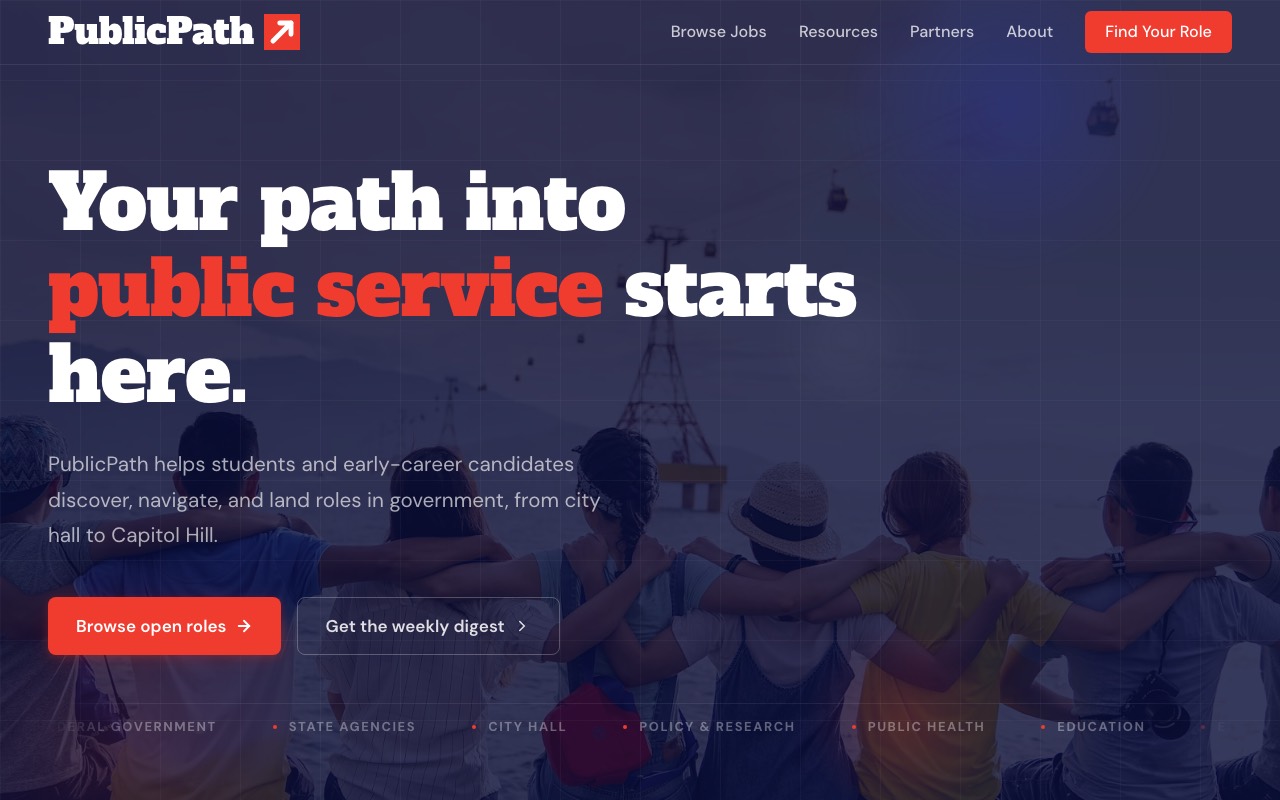
PublicPath homepage with the headline ‘Your path into public service starts here’.
PublicPath homepage, captured 6 October 2026. This is the team’s product; it does not show my ingestion work, which is described above. Project website ↗ Job search was not loading when checked on 6 Oct 2026.
How it works (simplified data flow)
  1. Listings come from external job APIs.
  2. Python ingestion is scheduled to run daily with GitHub Actions. my work
  3. Data-quality steps clean, deduplicate, normalize, and validate listings. my work
  4. Listings are stored in Postgres on Supabase.
  5. The site’s search and filters read from that store.

Tools: Python, GitHub Actions, Supabase, Postgres.

↑ Back to overview

03 · Research Assistant, HOPE Lab, UChicago Booth

CLARITY

Turning clinical notes into patient-friendly explanations.

What it does

CLARITY is a healthcare-AI research project; its pipeline turns de-identified clinical notes into patient-friendly explanatory videos.

What I built

I built the Python pipeline. It takes de-identified clinical-note JSON and automates the explanatory content, narration with Microsoft Neural TTS, slide generation, and MP4 production.

Output

MP4 explanatory videos.

Clinical material is not public, so no example is shown here.

How it works (pipeline sequence)
  1. Input: a de-identified clinical note in JSON.
  2. Explanatory content is produced from the note. my work
  3. Narration (Microsoft Neural TTS) and slides are generated. my work
  4. Both are assembled into an MP4. my work

Tools: Python, Microsoft Neural TTS.

↑ Back to overview

Supporting work

  • Energy Market Intelligence

    Ourea Energy · separate from Ourea Brain

    Built a weekly AI-assisted workflow that filtered 50+ recurring signals across energy storage, utilities, and data centers into leadership updates.

  • Chicago Eviction Risk

    Applied ML · private repository

    Built an interpretable machine-learning and geospatial workflow to explore eviction-risk patterns in Chicago.

  • Political Narrative Navigator

    Team project, University of Chicago

    Analyzed 2,000+ presidential campaign speeches alongside YouGov data using AI-assisted text workflows.

    Team repository on GitHub ↗

Background

I combine software building with applied research in machine learning, survey analysis, and geospatial work.

  • Ourea Energy — Agentic AI Intern · 2026–
  • Financial Health Network — Research Intern, Data Analytics · 2026–
  • HOPE Lab, UChicago Booth — Research Assistant · 2026–
  • PublicPath — Co-founder, Engineering and Data · 2026–
  • PAMS — Research Associate, ML · 2025 · CERP — Analyst · 2024–25
  • MS, Computational Analysis and Public Policy, UChicago · expected June 2027
  • BS, Economics and Political Science, Lahore School of Economics · May 2024